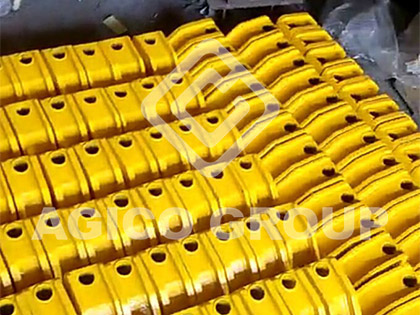
A railroad slide baseplate supports the stock rail and provides the sliding surface on which the switch rail moves during turnout operation. AGICO offers drawing-based supply coordination for one-piece cast slide baseplates used in railway and metro turnout projects.
This design combines an integral cast body with a wear-resistant sliding surface. It addresses the fatigue-sensitive connection between the sliding table and baseplate in conventional welded designs, while retaining toughness at the stock-rail hold-down.
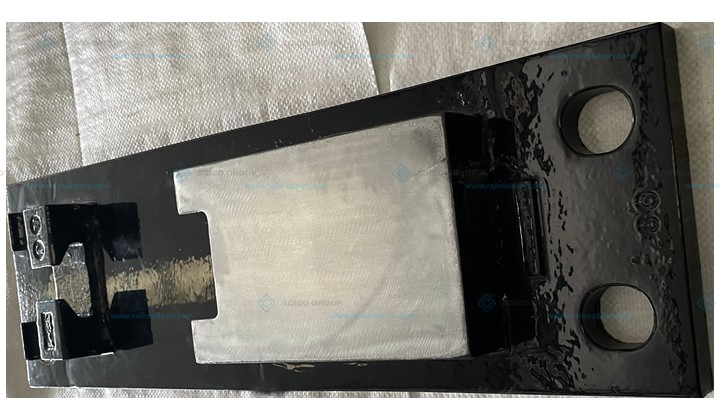
- Construction: precision-cast integral body with a locally treated sliding surface.
- Application: switch-rail support in compatible railway and metro turnouts.
- Selection: rail profile, turnout drawing, mounting holes and fastening interfaces reviewed for each order.
- Project support: review of replacement requirements and associated support components, subject to the agreed supply scope.
How a Railroad Slide Baseplate Works
Slide baseplates are installed along the movable switch-rail region of a railway turnout. The baseplate transfers loads to the bearer or sleeper, the sliding table supports the switch rail, and the stock-rail hold-down forms part of the stock-rail restraint. The complete fastening arrangement depends on the approved turnout design.
The terms turnout slide plate and slide chair plate are also used for related components. In some systems, the slide chair is a separate part mounted on another plate; the product described here uses an integral cast body. A general rail tie plate is not automatically interchangeable with a slide baseplate.
Slide Baseplate Structure and Component Functions
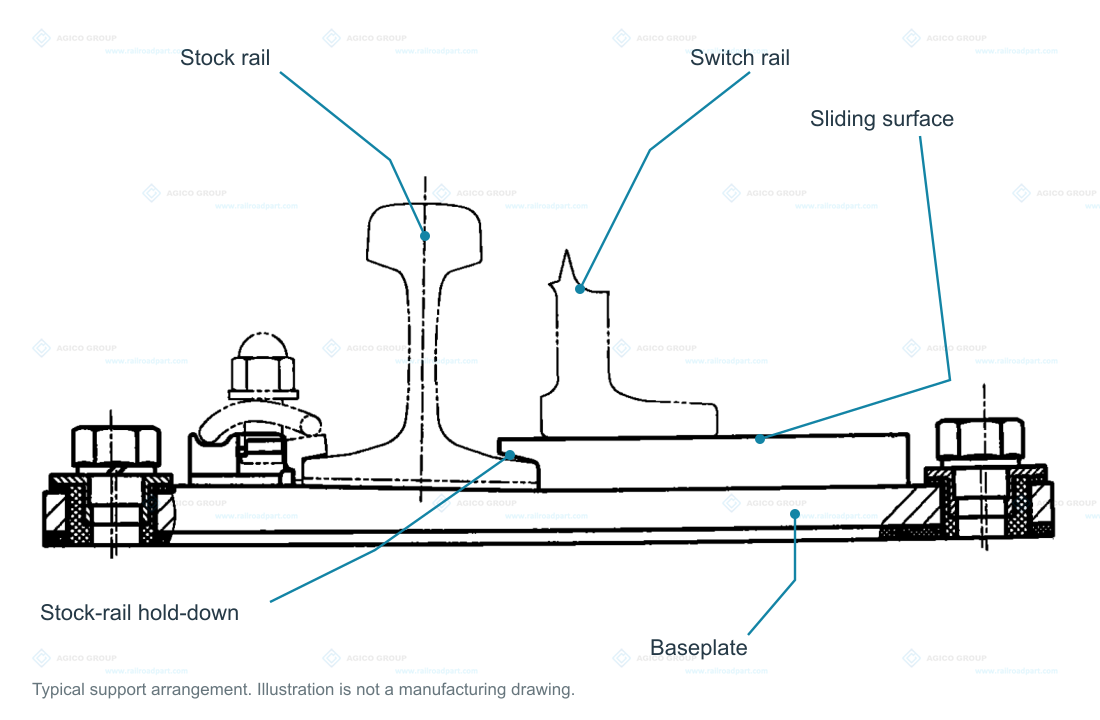
The assembly below identifies the main support interfaces of slide base plate. The stock rail is the fixed rail; the switch rail moves across the sliding surface. A slide chair is the supporting element below that moving rail, while the baseplate distributes loads to the bearer. In this rigid arrangement, a stock-rail hold-down overlaps the stock-rail foot.
Slide Baseplate Sliding Surface and Slide Chair
The sliding surface supports the switch-rail foot and provides its movement path. The slide chair is the structural support, not simply another name for the surface coating. Depending on the fastening system, the chair may be separate from the baseplate or incorporated into a one-piece body.
Stock-Rail Hold-Down on the Slide Baseplate
The stock-rail hold-down is the feature that overlaps the stock-rail foot in the illustrated rigid arrangement. Other designs use internal elastic fastening. The baseplate carries the assembly and provides its bearer-fastening interfaces. Customer shall confirm the fastening arrangement from the project drawing rather than treating these designs as interchangeable.
Cast Slide Baseplate Design and Wear-Resistant Surface
One-Piece Cast Slide Baseplate Structure
In a conventional welded slide plate, the sliding table is joined to the baseplate by welds. Repeated loading can concentrate stress at that connection. Precision integral casting removes this particular welded joint from the body design. Material quality, casting integrity and dimensional control remain essential to performance.
Wear-Resistant Surface Treatment for Slide Baseplates
Our factory offers a composite hardening treatment applied to the switch-rail sliding area. The stock-rail hold-down is not given the same hardening treatment, allowing the design to combine a harder working surface with a tougher hold-down region. This local treatment is intended to improve resistance to scoring and wear without hardening every part of the casting to the same level.
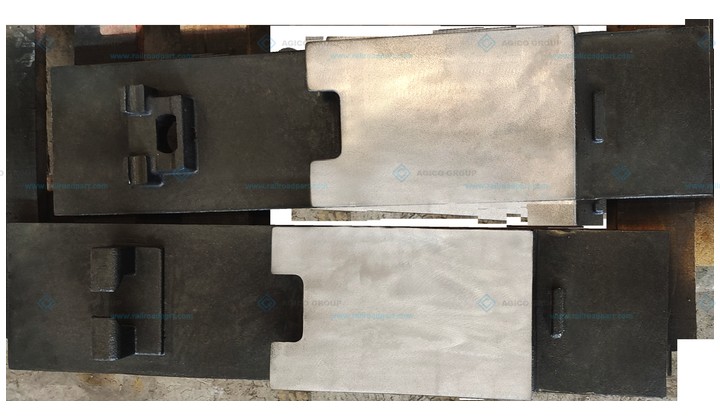
The development records shows a laser-applied wear-resistant surface. Confirm the production process, alloy specification, layer thickness and inspection method for the ordered model. Historical trials of other surface technologies should not be treated as simultaneous manufacturing steps for every supplied part.
Common Slide Baseplate Problems in Railway Turnouts
Our factory makes field investigations shows identify weld separation, baseplate fracture, stock-rail hold-down fracture, corrosion and surface scoring as recurring problems on existing slide plates. Uneven support, worn pads, loose fasteners, incorrect track geometry and debris can make these conditions worse.
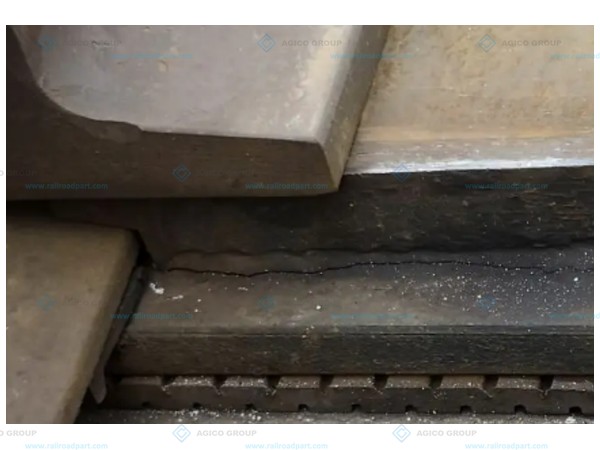
Weld separation
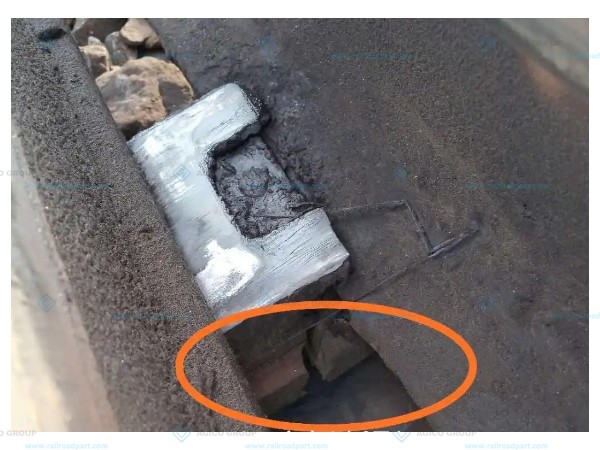
Baseplate fracture
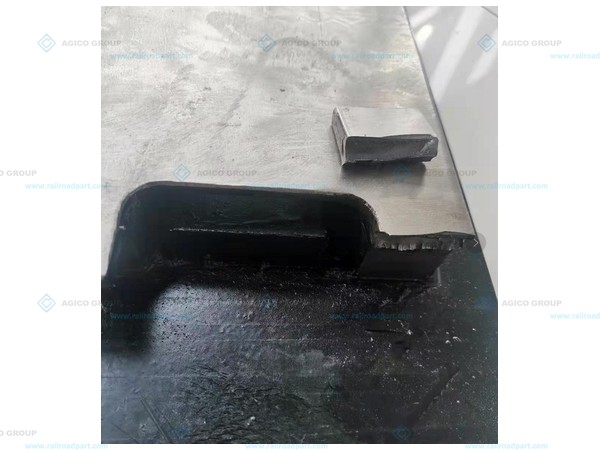
Stock-rail hold-down fracture
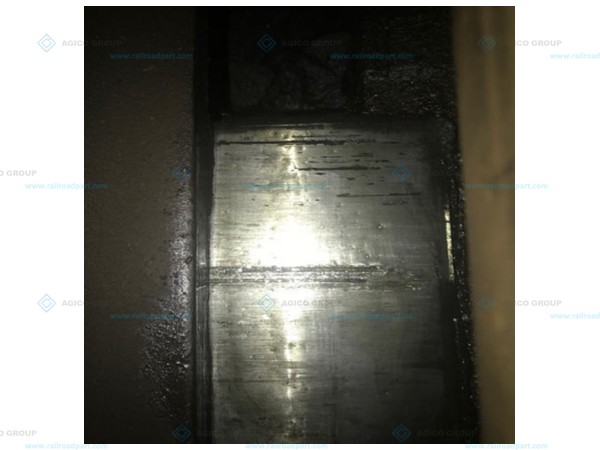
Sliding-surface scoring
Examples of damage to existing components from the manufacturer investigation records.
Slide Baseplate with an integral cast body and a harder sliding surface shows advantages of specific structural and wear concerns. They do not eliminate every cause of turnout failure. A replacement should be considered together with the condition of the supporting pads, fastening system, rail alignment and switch operation.
Cast Slide Baseplate Materials and Drawing Requirements
| Item | Product Information | Order Confirmation |
|---|---|---|
| Product form |
One-piece cast slide baseplate |
Approved part and assembly drawings |
| Body material |
20SiMn cast steel identified in source records |
Grade standard, condition and material certificate |
| Sliding surface |
Locally applied wear-resistant treatment |
Alloy, coverage, thickness and hardness |
| Stock-rail hold-down |
Not hardened in the same way as the sliding area |
Geometry and agreed mechanical requirements |
| Rail and turnout |
P60 examples appear in the supplied records |
Required rail section, turnout type and handedness |
| Dimensions and holes | Drawing-based |
Datums, hole centres, tolerances and rail seats |
| Associated parts | Project-dependent |
Pads, shims, braces, sleeves and fasteners |
Rail section and turnout number alone are insufficient to establish interchangeability. The source records reference a special-line drawing, but the complete drawing and revision should be supplied for technical review before ordering. No universal plate dimensions, tightening torque or pad thickness are specified here.
Slide Baseplate Production and Machining
Here are the workshops photographs show slide baseplate cast bodies, machined sliding surfaces and components staged for further work. Surface finish and component arrangement vary with the drawing and processing stage.
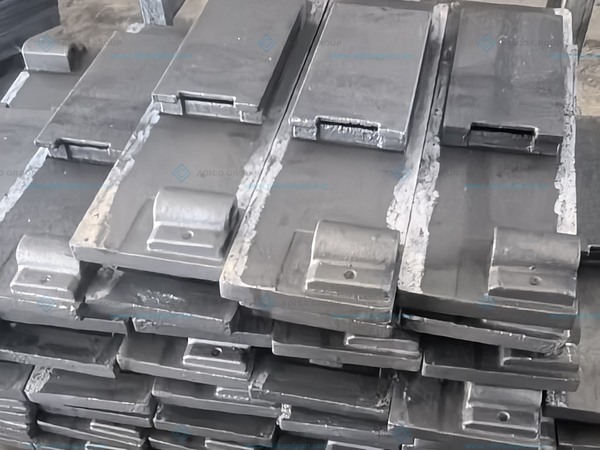
Cast bodies in the workshop
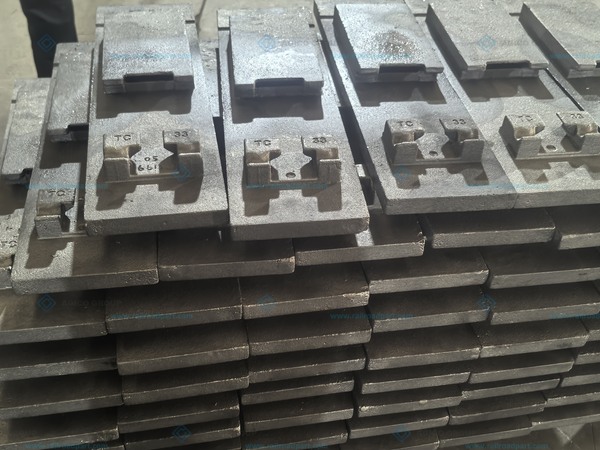
Cast baseplate batch
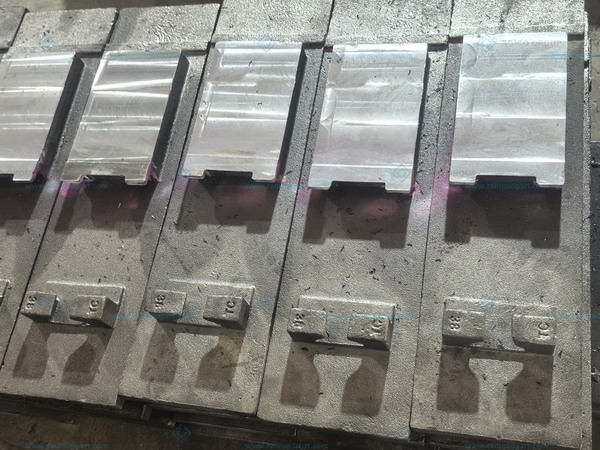
Machined sliding surfaces
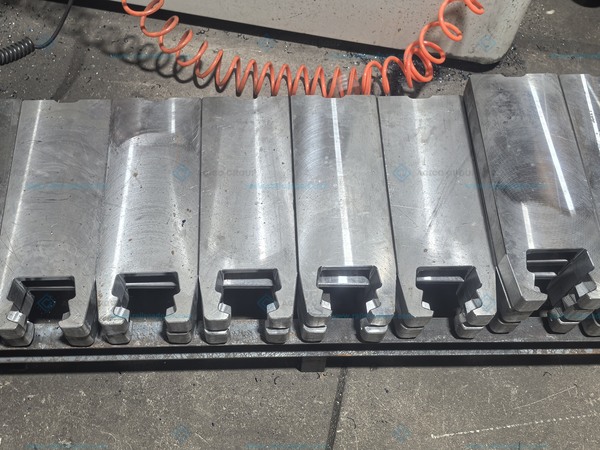
Machined component batch
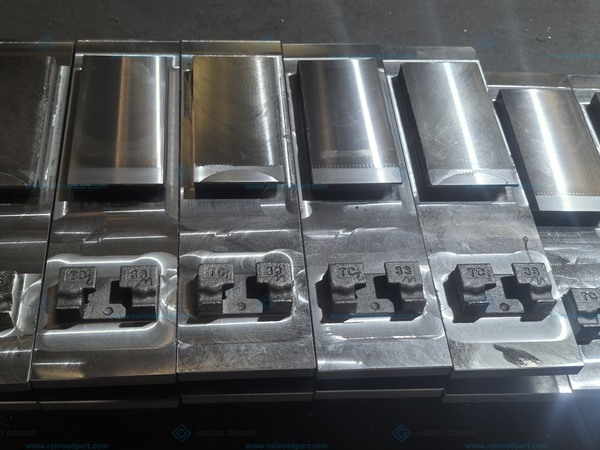
Finished-surface batch
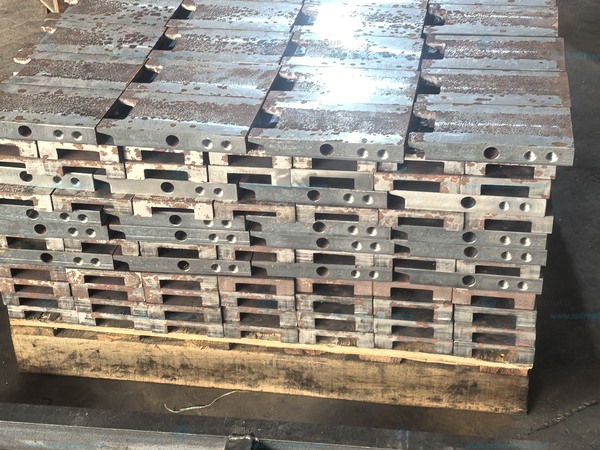
Workshop staging
Related Welded Rail-Support Variants
Here are 2 pictures show separate rail-support components joined to plates by visible welds. They can clearly show the workshop fabrication and are distinguished from the one-piece cast slide-baseplate body design of cast slide baseplate. The support arrangement and manufacturing route must be specified for each part.
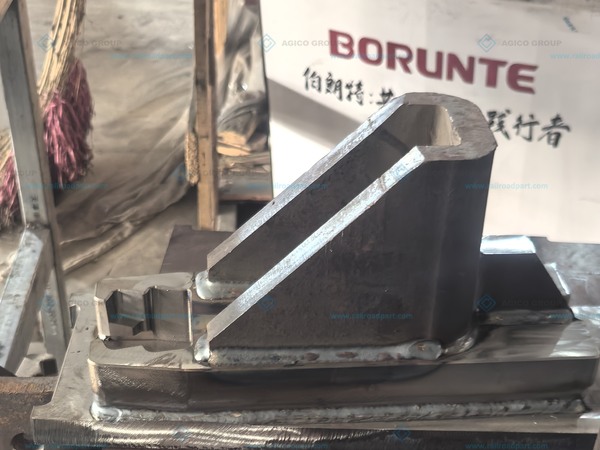
Welded rail-support variant
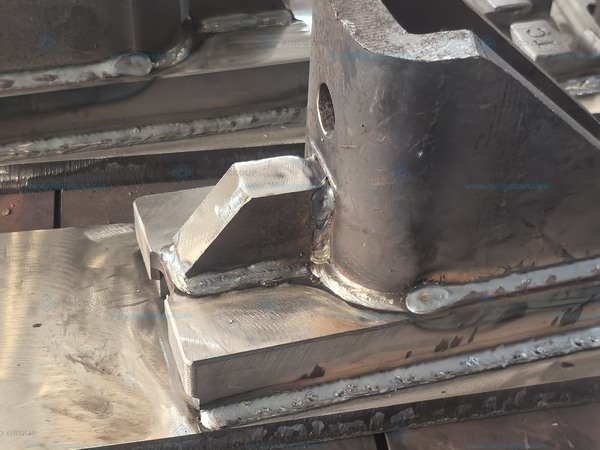
Rail-support fabrication detail
Cast Slide Baseplate Performance Data
Our factory has made tests, and recorded the comparison datasets of conventional slide baseplate and integral cast slide base plate. The records do not fully identify the sample batches or test conditions, so these figures are reference values rather than guaranteed properties for every order.
Slide Baseplate Laboratory Comparison
| Property |
Conventional Slide Plate |
Integral Cast Slide Baseplate |
Calculated Increase |
|---|---|---|---|
| Tensile strength | 370 MPa | 510 MPa | 37.8% |
| Yield strength | 235 MPa | 295 MPa | 25.5% |
| Reported impact value | 27 J | 39 J | 44.4% |
| Sliding-surface hardness | 156 HBW | 350 HBW | 124.4% |
Slide Baseplate Application Data Comparison
| Property |
Conventional Slide Plate |
Integral Cast Slide Baseplate |
Calculated Increase |
|---|---|---|---|
| Tensile strength | 375 MPa | 540 MPa | 44.0% |
| Yield strength | 224 MPa | 310 MPa | 38.4% |
| Reported impact value | 28 J | 56 J | 100.0% |
| Sliding-surface hardness | 148 HBW | 510 HBW | 244.6% |
Increases are calculated from the listed values relative to the conventional part. The source also reports grade 9 protection after 96 hours of salt spray for the treated surface, compared with extensive rusting on the conventional surface. Confirm the salt-spray method and rating standard, impact test conditions and hardness method against the original reports. The reported J values require confirmation of specimen size, notch geometry and test temperature.
Slide Baseplate Assembly Fatigue Test: 5 Million Cycles
A historical test report provides a more specific result for a submitted P60 slide-baseplate fastening assembly. Report JCBG(01)210201675, issued on 9 February 2021 by Sinosteel Zhengzhou Research Institute of Steel Wire Products Co., Ltd., records a five-million-cycle assembly fatigue test.
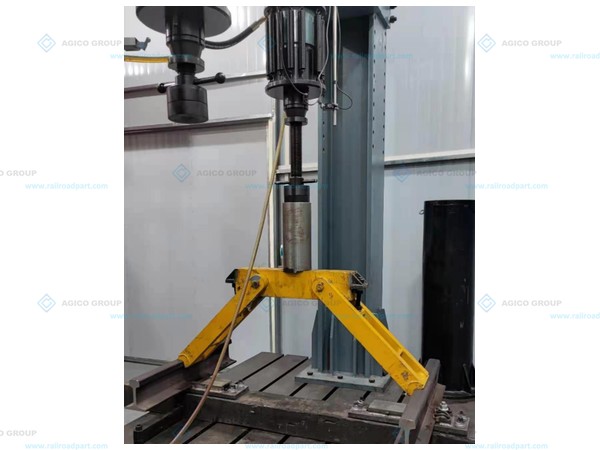
Assembly fatigue test
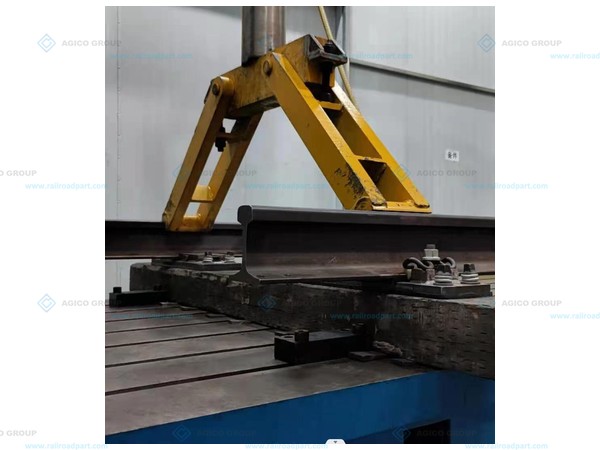
Fatigue loading fixture
| Report Item | Recorded Information |
|---|---|
| Manufacturer | Henan Tiechuang Railway Equipment Co., Ltd. |
| Sample |
P60 turnout slide-baseplate fastening assembly; two sets submitted |
| Test method cited | TB/T 2491-1994 |
| Assessment document cited | Q/TC J1001-2020 |
| Test cycles | 5,000,000 |
| Recorded result |
No fracture at the table-to-baseplate connection; no cracks observed with a 10× magnifier |
| Individual test verdict | Pass |
This result applies to the submitted samples and reported test conditions. The cited standard editions identify the historical test basis. Laboratory cycles should not be converted directly into a guaranteed number of service days or years. For a new order, confirm how the offered design corresponds to the tested assembly.
Slide Baseplates for Metro Turnouts and Retrofit Projects
The manufacturer's historical materials describe use or trials in Guangzhou, Shenzhen and Shanghai metro systems, together with site investigations and proposed improvements for Chengdu and Hefei. These references relate to the original manufacturer's products. AGICO's supply scope is confirmed separately for each project.
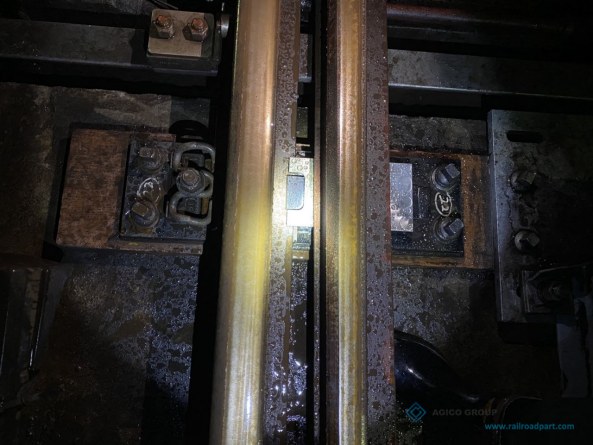
Guangzhou metro installation photograph from the manufacturer's historical application materials.
A retrofit may require more than replacing the baseplate. Depending on the measured site conditions, options can include slope-adjusting shims, revised support pads, external rail braces, bolt sleeves and a review of fastening geometry. Each option needs engineering confirmation for the actual turnout.
Where related parts are required, the inquiry can also include rail braces, rail pads and rail bolts. Compatibility and supply scope are confirmed during quotation.
Railway Slide Baseplate Inspection and Maintenance
The development records include fatigue testing, tensile and impact testing, flaw detection, metallographic examination and salt-spray testing. An order-specific inspection plan should identify the required tests, sampling, methods, acceptance limits and documents.
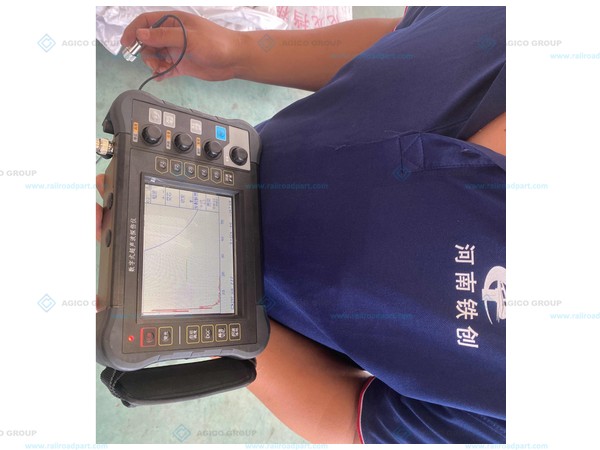
Flaw detection
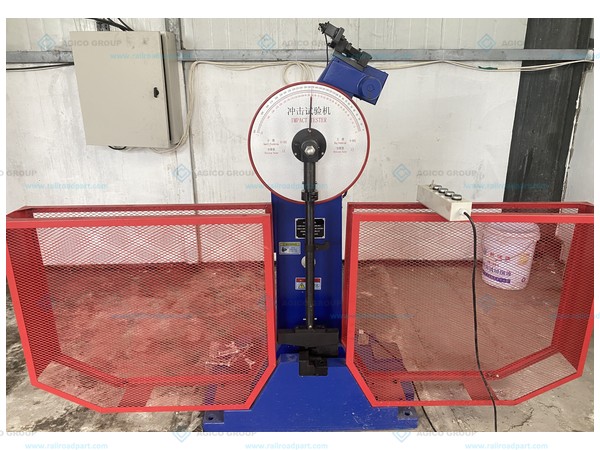
Impact testing
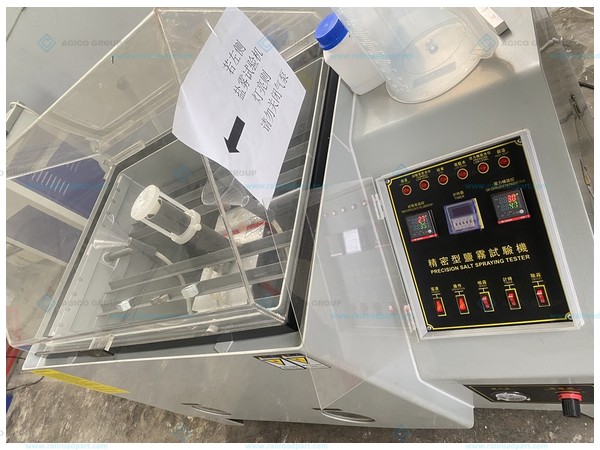
Salt-spray testing
In service, check the sliding surface, stock-rail hold-down, fasteners, supporting pads and contact conditions. Keep the sliding path clear of debris and investigate uneven plate levels or abnormal switch resistance. Lubrication and inspection intervals must follow the approved maintenance procedure; a wear-resistant surface is not, by itself, evidence of lubrication-free operation.
How to Specify a Replacement Slide Baseplate
For identification and quotation, send the approved drawing or as much of the following information as available:
- Rail profile, track gauge, turnout type and drawing revision.
- Plate position within the switch, part number and left-hand or right-hand arrangement.
- Overall dimensions, mounting-hole pattern, rail-seat geometry and reference datums.
- Body material, surface treatment and required mechanical properties.
- Existing pad arrangement, measured support levels and condition photographs.
- Required fasteners, rail braces, pads, shims and insulation components.
- Inspection documents, quantity, delivery destination and packing requirements.
AGICO coordinates technical review and project-specific sourcing. Availability, customization, documentation and delivery terms are confirmed for the agreed design and order quantity.
Railway Slide Baseplate FAQ
What is the difference between a slide baseplate and a rail tie plate?
A slide baseplate includes a working surface for switch-rail movement and interfaces with the stock-rail fastening arrangement. A general rail tie plate supports and fastens a rail but is not necessarily designed for switch-rail sliding.
Is this a roller slide baseplate?
No. This baseplate product has an integral cast body with a sliding working surface. A roller slide baseplate uses additional rolling elements and requires a different component arrangement.
Is the cast slide baseplate maintenance free?
No maintenance-free claim is made. The local wear-resistant treatment addresses surface wear, while lubrication, debris removal, support condition and fastening checks remain governed by the maintenance plan.
Can a cast slide baseplate replace a welded P60 slide plate?
Not on the basis of the P60 designation alone. Rail seats, hole positions, plate levels, fastening interfaces and turnout geometry must match the approved design.
Does slide baseplate fatigue testing guarantee service life?
No. The 5-million-cycle result is a particular laboratory test. Actual service life depends on loading, support conditions, installation, track geometry and maintenance.
Can custom cast slide baseplates be reviewed?
Yes. Send the drawing, required material and treatment, quantity and inspection requirements. Technical feasibility and the final supply scope will be confirmed during review.
Request a Cast Slide Baseplate Quotation
Send your turnout drawing, rail profile, plate position, quantity and delivery destination. For replacements, include photographs of the existing plate and supporting arrangement so the relevant interfaces can be reviewed before a supply proposal is prepared.