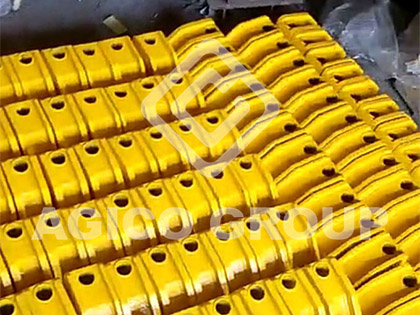
Composite Sleeper for Sale
Composite (PE and PU) railway sleepers - supplied from AGICO are featured with lightweight and corrosion-resistant, they have excellent screw holding capacity and are widely used in various railway lines. Here are the details:
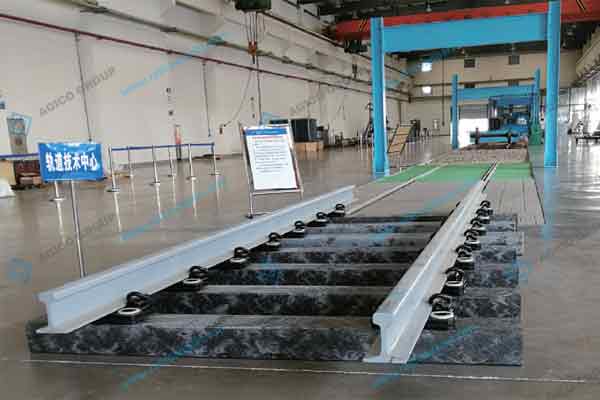
- Product Name: Composite Sleeper
- Material Type: PE Plastic Sleeper, PU Synthetic Sleeper
- Standard: CJ/T399-2012
- Service life: over 50 years
- Application: Suitable for railway, metro and industrial tracks
- Standard size (section): 230mm(Width)x150mm(Height)
Production Capacity: AGICO factory owns a set of composite sleeper production line, capacity of 30,000 pcs/ year. Composite sleeper height not less than 140mm, width not less than 200mm, and length according to customer need. Other specifications can be processed on customer's request.
Composite Sleeper Types
AGICO supplies mainly 3 types of composite sleepers: PE Sleeper, HDPE Sleeper, PU Synthetic Sleeper. Composite sleepers function the same as rail sleepers of other materials. Its primary function is to maintain the required gauge spacing between the rail tracks. The plastic sleeper functions well in supporting the rail, maintaining its position, and transferring the heavy pressure from the rail to the track bed. As composite sleepers have a certain degree of flexibility and elasticity, it is a better replacement for wooden and concrete sleepers in some cases.
PE Plastic Sleeper
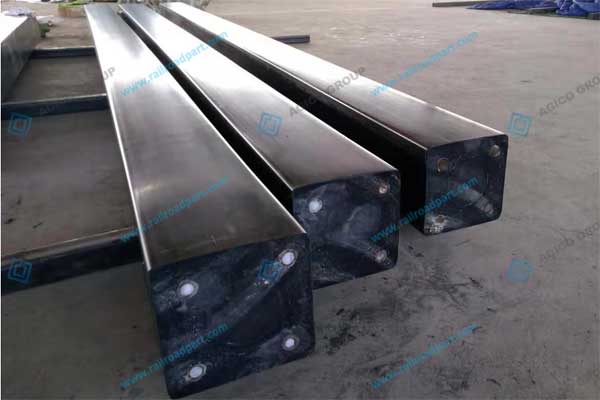
PE plastic sleeper is also called UHMWPE Sleeper, for it is made of Ultra High Molecular Weight Polyethylene. This special material has a high molecular weight, ranging from 3 to 7 million g/ mol.
PE Sleeper Specification
| Property | Value |
|---|---|
| Density | 0.92–0.96 g/cm³ |
| Tensile Strength at Yield | 15–20 MPa |
| Notched Impact Strength | 80–170 kJ/m² |
| Impact Intensity | 100–160 kg/m³ |
| Abrasion Resistance (Sand Slurry Test) | 70–120% |
| Wearing Coefficient | 0.15 Shore |
| Hardness (Shore D) | 63–68 |
HDPE Sleeper
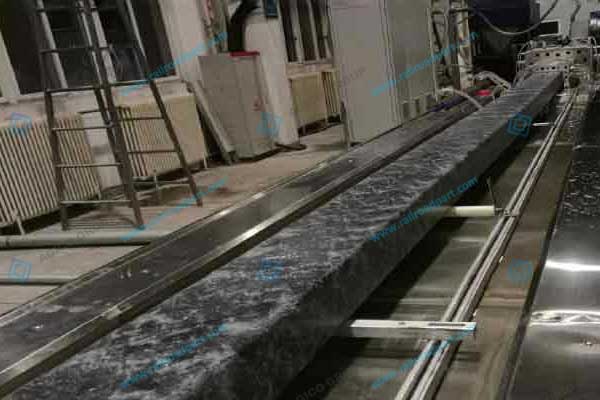
HDPE sleeper is made from recycled thermoplastics and inorganic fillers. It is a new type of sleeper that can replace wood or cement sleeper. Compared with wooden sleepers, it has significant advantages. It has less water absorption, better electrical insulating property, better anti-aging and anti-corrosion. It can be on-site sawing, drilling, grinding, nailing and so on.Size specifications can be customized according to customer needs. High spike holding ability is over time without decline with high anti-fatigue ability and durability. Sleepers do not only use recycled materials for manufacturing, once the product damaged, they can be re-recycled and does not affect the product performance toreduce environmental pollution.
HDPE Sleeper Specification
| Property | Value |
|---|---|
| Density | 1.2 ± 0.10 g/cm³ |
| Bending Load Without Crack | ≥ 160 kN |
| Vertical Compression Strength | ≥ 80 MPa |
| Shear Strength | ≥ 7 MPa |
| Fatigue Property | 3 × 10⁶ Cycles Without Crack |
| Screw Spike Pullout | ≥ 40 kN |
PU Synthetic sleeper
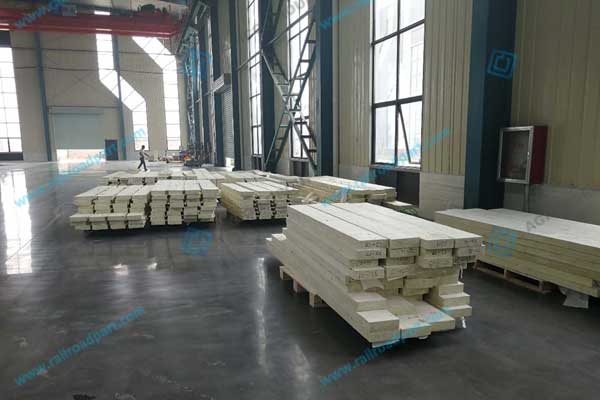
The synthetic sleeper is made of long glass fiber as the reinforcing material, with polyurethane resin as base material to be foamed, solidified and synthesized. At the beginning, two kinds of liquid polyurethane raw materials of A and B are sent to mix by the metering pump in certain ratio at the head facility, then uniformly poured onto the glass fiber surface, and after being evenly kneaded, it is then foamed, solidified and formed into a rolling mold, and finally the synthetic product is automatically tracked and cut at the production line. The semi-finished product is cut into a certain length as needed, and then grinded, compounded, coated or sprayed to become a finished product.
PU Sleeper Specification Compared to JIS E1203
| Item | JIS E1203:2007 Strength |
(CJ/T399-2012) AGICO Sleeper Strength |
|
| Material Strength | Bending Strength | min. 70 N/mm2 | min. 80 N/mm2 |
| Young 's modulus in flexure | min. 6000 N/mm2 | min. 7000 N/mm2 | |
| Withstand bending load | min. 170 kN | min. 170 kN | |
| Longitudinal compressive strength | min. 40 N/mm2 | min. 50 N/mm2 | |
| Shearing strength | min. 7 N/mm2 | min. 7 N/mm2 | |
| Adhesion shearing strength | min. 7 N/mm2 (base-material breakage) | min. 7 N/mm2 (base-material breakage) | |
| Electrical Properties | Alternating-current breakdown voltage | min. 20 kV | min. 20 kV |
| Direct-current insulation resistance | min. 1 X 10¹⁰ Ω | min. 1 X 10¹⁰ Ω | |
| Pulling Strength | Track spike pulling strength | min. 15 kN | min. 20 kN |
| Screw spike pulling strength | min. 30 kN | min. 40 kN | |
| Unit volume mass | 0.74土 0.1 g/cm3 | 0.74土 0.1 g/cm3 | |
| Amount of water absorption | max. 10 mg/cm2 | max. 10 mg/cm2 | |
Synthetic Sleeper Production Process
The synthetic sleeper is made of long glass fiber as the reinforcing material, with polyurethane resin as base material to be foamed, solidified and synthesized. At the beginning, 2 kinds of liquid polyurethane raw materials of A and B are sent to mix by the metering pump in certain ratio at the head facility, then uniformly poured onto the glass fiber surface, and after being evenly kneaded, it is then foamed, solidified and formed into a rolling mold, and finally the synthetic sleeper former product is automatically tracked and cut at the production line. The semi-finished product is cut into a certain length as needed, and then grinded, compounded, coated or sprayed to become a finished sleeper product.

Mechanical Properties of Composite Sleeper
| Property | Unit | Testing Method | Value |
|---|---|---|---|
| Molecular Weight | 1E6 g/mol | ASTM D4020 | 3–5 |
| Density | g/cm³ | ISO 1183-1 | 0.93–0.96 |
| Dynamic Coefficient of Friction | - | ISO 8295 | ≤ 0.15 |
| Notched Impact Strength (Charpy) | kJ/m² | ISO 11542-2 | 140–170 |
| Abrasion Index (Sand-Slurry) | - | ISO/DIS 15527 | 100–110 |
| Hardness (Shore D) | - | ISO 868 | 63–70 |
| Elongation at Break at 23°C | % | ISO 527 | ≥ 270 |
| Yield Strength | MPa | ASTM D638 | 20.2 |
| Tensile Impact | Ft-lbs/in² | ASTM D1822 | ≥ 436 |
| Water Absorption | - | ASTM D570 | ≤ 0.1 |
| Compressive Deformation | % at 1000 psi | ASTM D621 | 6.0–8.0 |
| IZOD Impact | Ft-lbs/in² | ASTM D4020 | Non-break |
| Thermal Expansion | K-1 | DIN 53752 | ≈ 2 × 10⁻⁴ |
| Melting Temperature | °C | DIN 53736 | 135 |
| Operating Temperature | °C | - | -80 to +80 |
| Volume Resistivity | Ohm-cm | DIN 60093 | 1014 |
| Surface Resistivity | Ohm | DIN 60093 | 1015 |
Test Reports of Composite Sleeper
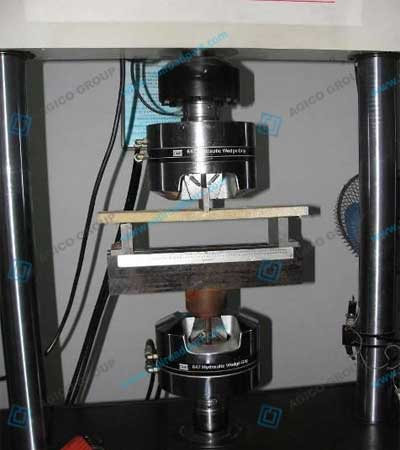 Bending Resistance Test
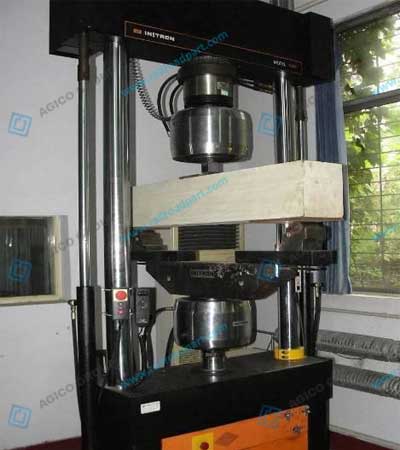 Bending Strength Test
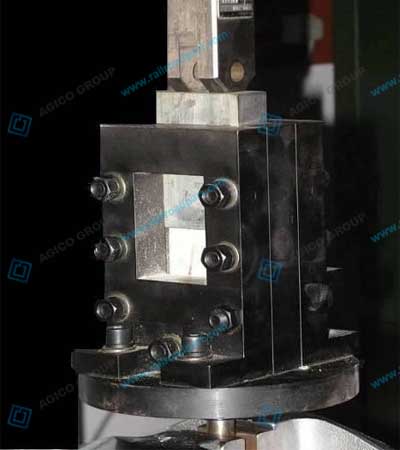 Shear Strength Test
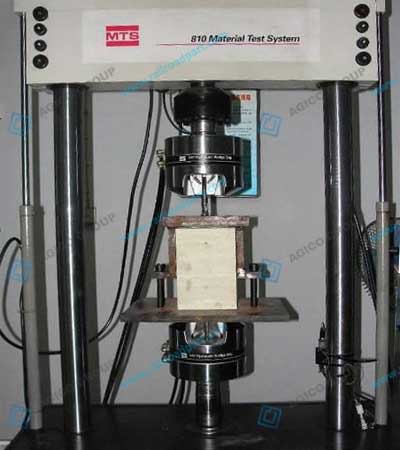 Spike Pull-out Strength Test
Here are the test reports of 2 composite sleeper models: W416-204A and WP417-302A
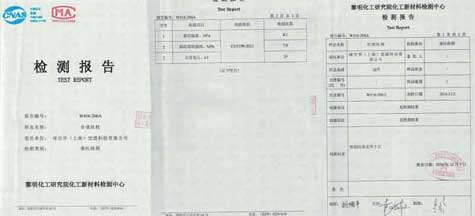
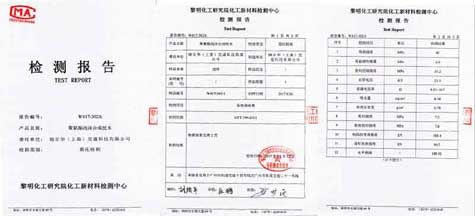
| No. | Item | Results | Standard | Remark | ||||||||||||
|---|---|---|---|---|---|---|---|---|---|---|---|---|---|---|---|---|
| 1 | Bending Strength After UV Aging |
|
ASTM D4329-13 |
Radiation intensity 0.89 W/(m²·nm) 250 h |
||||||||||||
| 2 | Dielectric Strength | 3.89 kV/mm | GB/T 1408.1-2016 | |||||||||||||
| 3 | Surface Resistivity | 1.2 × 10¹⁵ Ω | GB/T 1410-2006 | |||||||||||||
| 4 | Dynamic Fatigue Test | The sample structure is stable without damage. The horizontal displacement of the rail head is 2.5 mm, and the vertical displacement of the rail head is 2.8 mm. | Provisional Specification for Composite Sleepers (2014) (REV.01/2017) |
4T-20T in 5 Hz; Repeat 2 million times |
||||||||||||
| 5 | Impact Load | Permanent plastic deformation was observed at the impact location. The groove depth was 15 mm after the first impact and 20 mm after the second impact at the same position. |
Wheel weight: 580 kg; Lifting height: 750 mm; Repeat 2 times |
|||||||||||||
| 6 | Inflammability | Oxygen index 25.0%. Horizontal burning test: after burning the sample for 20 s and removing the flame, no flaming was observed and the burning line did not reach the 25 mm limit line. V-0 level. | ||||||||||||||
| 7 | Screwing / Unscrewing | Spike pullout force: 67.79 kN | ASTM (2010 version) 4.9.1.9 | 8 times | ||||||||||||
| 8 | Displacement Under 500 kN | 5.32 mm | ||||||||||||||
| 9 | Coefficient of Linear Thermal Expansion |
90 × 10-6 mm/(mm·K) (-30°C to 30°C) 123.19 × 10⁻⁶ mm/(mm·K) (-30°C to 90°C) |
ASTM 831:2014 |
Composite Sleepers Successful Cases
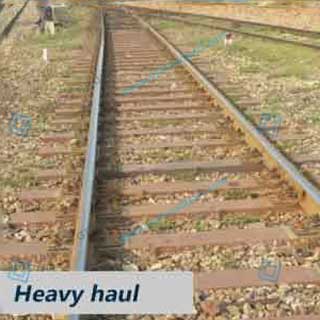
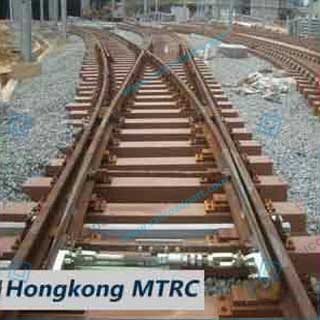
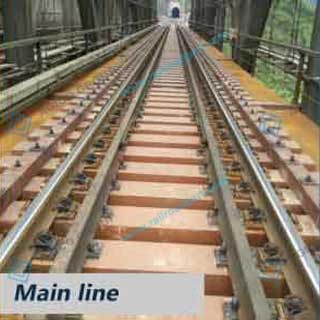
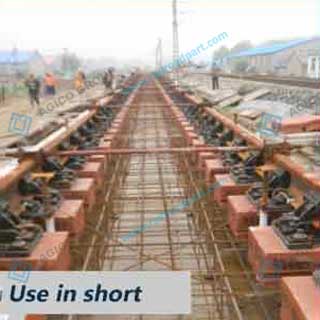
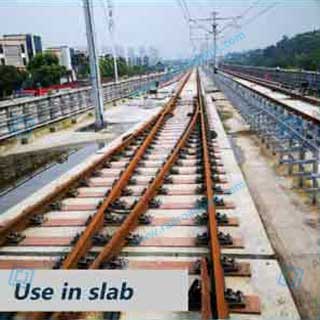
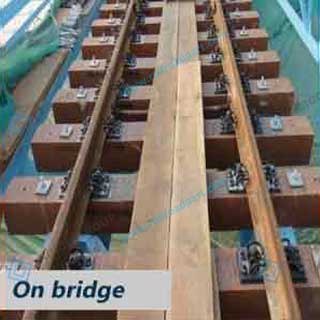
At present, our company can produce and develop various rail sleeper products, including the various types of composite sleepers, wooden sleeper, steel sleeper and concrete sleeper. From 2018 on, we have successfully developed FFU synthetic sleepers which can be used as an equivalent of Japan Sekisui sleepers, but with more competitive price.
Composite Railway Sleepers Advantages
- High strength Material: Composite sleeper is made from recycled plastic composites or fiber-reinforced polyurethane. It is a new type of sleeper that designed to provide excellent durability, electrical insulation and environmental resistance. can replace wood or cement sleepers.
- Improved Properties: Compared with wooden sleepers, it has no water absorption, better electrical insulating property, better anti-aging and anti-corrosion. It can be on-site sawing, drilling, grinding, nailing and so on. Size specifications can be customized according to customer needs. High spike holding ability isover time without decline with high anti-fatigueability and durability.
- Material Recycable: Composit sleepers do not only use recycled materials for manufacturing, once the product damaged, they can be re-recycled and does not affect the product performance to reduce environmental pollution.
- Installation & Maintenance: Onsite processing is the same as that of wood sleeper. It can be machine grooved on the side of the sleeper, drilled a hole on the top of the sleeper on-site. In the absence of special circumstances, the product is maintenance-free.