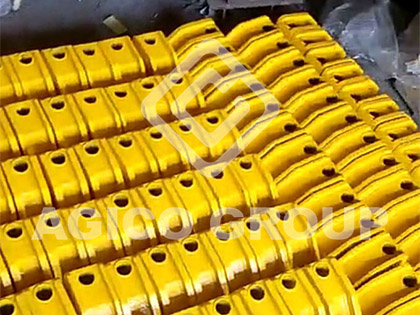
MainTypes of Rail Braces for Sale
AGICO supplies rigid rail brace, elastic rail brace, adjustable rail braces for rail track fastening, which can be classified into 2 types according to the installation methods, one is Integrated Rail Brace, featuring an integrated baseplate design, it requires no baseplate and is installed below the rail track, the other is the separate rail brace installed by rail track's side.

- Product Name: Rail Brace
- Steel Material: carbon steel, q235b
- Brace Types: Rigid rail brace, elastic rail brace, adjustable rail brace
- Dimension: 115re rail, 50kg rail, 136RE rail, or according to customer requirements
- Surface Treatment: Galvanized, black oiled, etc.
Rail Brace Baseplate
 Integrated Rail Brace Base Plate
The rail brace baseplate, located between the rail track and sleeper, is an important component in the track structure, playing a significant role in vibration damping within the wheel-rail dynamic system. With the development of heavy-haul railway transportation and increasing axle loads, higher demands are placed on baseplate performance as rails become heavier. Baseplates are required to have good vibration-damping performance, impact resistance, and long service life. Currently, there are 3 production processes for rail braces and baseplates: forging, casting, and rolling. Customization is available at AGICO based on different customer requirements.
Rail braces are components in railway tracks that resist lateral forces between wheels and rails. They are mainly installed on the outside of rails, particularly on the outer rails of small-radius curves and at switch points. According to sleeper types, they are categorized for wooden sleepers and concrete sleepers. Rail braces are often made of Q235 steel plates, with corners subjected to bending processes. Some structures are welded to form integrated connections.
Adjustable Elastic Rail Brace
 Adjustable Elastic Rail Bracing for Railway Switches
The adjustable elastic rail bracing for P50 and P60 concrete curves in railway switches consists of an adjustable main body and a rack base, with a rack slope of 12°–15° and a tooth pitch of 10–15 mm, enabling dynamic track gauge adjustment. Elastic rail braces are often installed on the non-working side of stock rails in railway switch points, guide curve rails, guard rails, and also on stock rails of double-switch mechanisms in double-slip switches, to prevent rail overturning and gauge expansion.
Rigid Adjustable Rail Brace
 Rigid Adjustable Rail Brace Mold
 Rigid Adjustable Rail Brace Stock
Anti-Creep Rail Brace
 Rail Brace Install Position
Anti-creep rail braces are bolted to stock rails to restrict longitudinal movement and ensure structural stability. Type II rail braces enhance track strength on small-radius curves, reducing rail deformation and wear. Replacement operations use specialized tools to adjust track geometry, improving switch durability and wear resistance.
Anti-Creep rail brace works with the stock rail, baseplate, switch sleeper bolts, and switch sleeper. With pre-drilled bolt holes spaced along the length of the stock rail. The anti-creep rail brace is connected to the stock rail via rail bolts and lock nuts, with its side claws gripping the baseplate. The baseplate is connected to the switch sleeper via switch sleeper bolts.
Advantages: It effectively restricts the longitudinal position of the stock rail, prevents relative displacement between the stock rail and switch sleeper, and ensures the stability of the switch mechanism and high smoothness of the switch.

Side-Jaw Clip
- Side-Jaw Clip (AREA 222) Non-adjustable: Forged steel construction. For use with horizontal switch rod. Manufactured as left-hand or right-hand.
- Adjustable Side-Jaw Clip (AREA 222) Adjustable: Forged steel construction. For use with horizontal switch rod. Manufactured as left-hand or right-hand.
Rail Brace Introduction
A rail brace is a type of rail fastening component made of carbon steel and produced in various shapes. It is installed on the outside of the rail in railway track fittings to effectively resist lateral forces from wheels and rails, when trains pass through, its main function is to prevent excessive lateral displacement or even rail overturning caused by high lateral forces on small-radius curved tracks. Rail braces are commonly installed on wooden sleeper tracks, railway switch points to enhance lateral stiffness.
Rail Brace Install Locations and Manufacture


Since rail braces are mainly installed on small-radius curves and at switch points, the installation location may vary due to the track design. They help prevent lateral displacement and rail overturning, improving track stability. Based on assembly methods, rail braces are classified into integrated types (with baseplates) and separate types. Ordinary Rail braces are made of q235 steel plates with corners formed by bending process, drilling bolt holes and weld neccesary steel structure to form integrated connections.
50 Rail Brace
 50 Rail Brace
The 50 Rail brace is designed for wide use on various railway lines with 50 kg/m rails. There are also other rail braces for steel rails of different weight per meter: 15 rail brace, 18 rail brace, 22 rail brace, 24 rail brace, 30 rail brace, 38 rail brace, 43 rail brace, 60 rail brace. It is a Chinese grade model designed for 50 kg/m rails, acting as a key fastening component in the railway track system.
- Function: During railway operation, 50 rail braces enables rail track withstand both significant lateral and longitudinal forces generated by train movement. It effectively resists lateral displacement and tilting tendencies, maintaining the rail track stability and ensuring train operation safety. These complex external forces can easily cause rail track tilting or displacement, affecting track geometry and train operation safety.
- Feature: The 50 rail brace features the same structural design as the other models, with a large weight per piece. It provides strong lateral support when tightly installed between the rail bottom and the rail sleeper.
Heel Outer Rail Brace

The heel outer rail brace is mainly used on the outer rail of railway switches. In rail switch areas, outer rail of switch bears significant lateral forces and impacts while trains pass frequently and directions change constantly. It is a cost-effective method for maintaining precise track gauge, and works with the rail switch components to ensure the safety when train is passing through, and reliable operation of rail switches during frequent train transitions, and extending the service life of switch components.
Function: The function of heel outer rail brace is to provide strong support to the outer rail, effectively enhancing its lateral stability and preventing deformation or displacement due to excessive force.
Rail Brace Manufacture and Install Requirements
 Rigid Rail Brace Drawing
 Rigid Rail Brace Drawing
- Material Standards: Typically made of high-quality carbon steel or low-alloy steel, such as Q235 carbon structural steel. Its moderate carbon content ensures adequate strength and toughness to adapt to the complex stress environment of railway tracks. The yield strength is usually no less than 235 MPa, and tensile strength ranges from 370 to 500 MPa, ensuring stable support between the sleeper and rail and resisting vertical and lateral impacts generated by passing trains.
- Dimensional Accuracy Standards: Dimension of the rail race need to be accurate to ensure a tight fit with the rail and sleeper after installation. For AGICO factory, the Length tolerance is controlled within ±2 mm; width tolerance is approximately ±1 mm, and height tolerance is ±1.5 mm. Why limit the tolerance? The rail brace needs to fit properly with surrounding rail parts, preventing track structure loosening or deformation, or it will affect operational safety. On high-speed railway lines, rail brace production requirements are stricter, with length tolerance reduced to ±1 mm.
- Installation and Performance Standards: rail brace need to be installed with the gap not exceeding 0.5 mm between the rail brace and the rail web. It is connected to the rail sleeper with rail bolt and elastic rail clips torque meeting design requirements.For example, on mixed passenger and freight railway lines in ordinary track sections, torque is 80–120 N·m, while on heavy-haul railways, high-speed railways, and other special lines, it is adjusted to 150–200 N·m based on design. This requirement ensures the rail brace in position when bearing frequent dynamic loads from trains, rail brace works with other fastening systems to securely fix the steel rail to the rail sleeper. Generally speeking, rail brace maintains track gauge and alignment stability, laying the foundation for safe and high-speed train operation. AGICO supplies customized rail braces for different railway projects, we can adjust specific details of rail brace standards based on their characteristics and design specifications. Contact us if you need any rail brace models or customized production, AGICO is always your realiable railway solution provider.