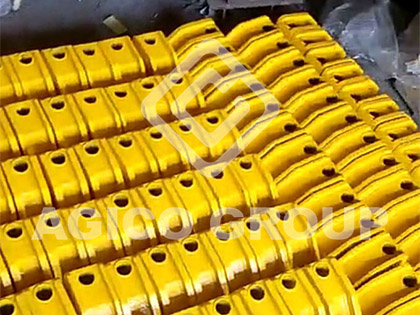
Long Seamless Rails
In the ordinary railway line with seams, in order to meet the requirements of the thermal expansion and contraction of the rails, every other standard 25-meter-long rail will leave space for rail joints and gaps, and the rails will shorten and elongate as the temperature changes, and its internal stress will be released through the rail track. However, there are many shortcomings in this kind of railway line with seam, one is to reduce the speed of the vehicle, the second is to damage the rail joints, and the third is to increase the maintenance frequency of the line and increase the cost of maintenance and repair. Therefore, the development of seamless rail track is a general trend.
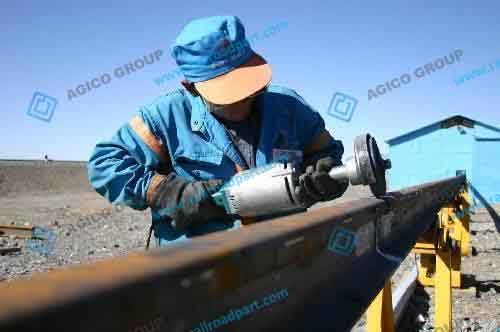
Grinding Seamless Rails
A seamless railway line is a long rail line which is welded to standard length rails and extends up to several kilometers. Then, if the standard short rails are welded to rails that have grown up to several hundred meters or even several kilometers in length, how will the problem of stress release inside the rails be resolved once thermal expansion and contraction are encountered? If this problem is not solved, the stress caused by the temperature change of the rails will not be released, which will result in the rails squeezing or pulling each other. When the steel rails are twisted, the rails will be distorted, and the rails will be broken, which will cause safety problems for the railway operation.
At present, the method to solve this problem in the seamless railway line is to do stress relief and rail temperature locking before the long rail welding. The so-called "stress dispersion" is to extend and retract the rails within a suitable rail temperature range, counteracting the temperature inside the rails, and then relocking the lines. "Rail temperature lock" means that the rails are locked in a temperature range with reference to the annual maximum and minimum temperature values in the paved areas, so that even if the seamless line is in thermal expansion and contraction, the generated stress is within the permissible range, it can cause steel rail expansion and pull off.
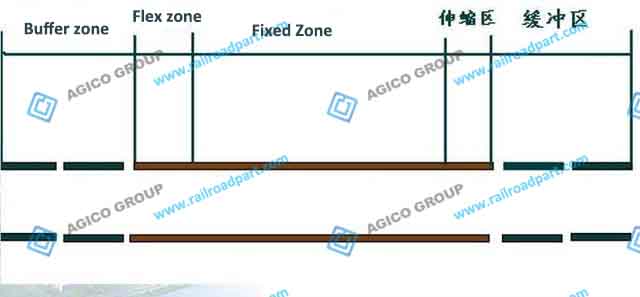
 Schematic Diagram of Seamless Line
The laying of the seamless line is divided into 3 parts: fixed zone, flexible zone and buffer zone. The lines in the fixed area are all locked, and some track gaps are left in the telescoping area to meet the stress release requirements. The buffer zone is the transition section of the seamless line to the seam line. In accordance with the different lengths of seamless lines, it can be divided into ordinary seamless lines with a length of 1 to 2 kilometers; the area of seamless lines is laid between two stations; cross-section of seamless lines, laying length It can include one or several stations, which can last for tens or even hundreds of kilometers.
There are many advantages to laying seamless lines on the railway, and for passengers can no longer hear the continuous clash of wheels and rail joints when we are in the train.
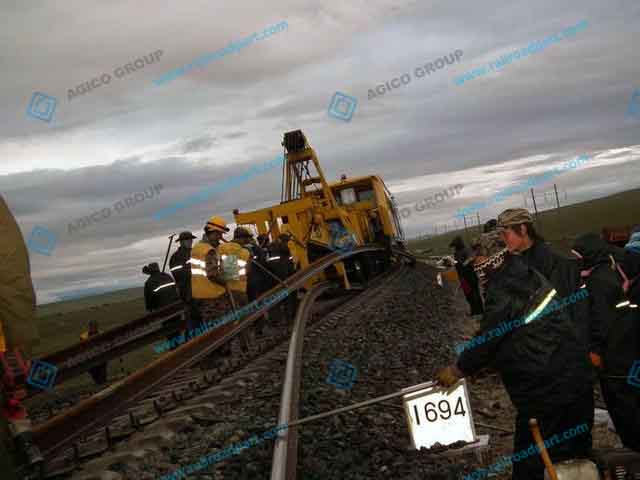
The railway track of the Qinghai-Tibet Railway were changed, the original short track was changed to a long track, and the long tracks were welded together.