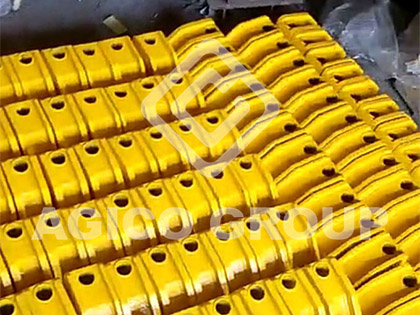
How Railway Joints works with Rail Tracks


Tips on Raiway Joints and Railway Line safety
- Choose steel rails and rail joints according to railway requirements
- Regular inspection and maintenance of railway line parts.
- Repair or replacement of railway part when rail joint failure occurs.
- Selection of rail lubricators, as well as inspection and maintenance work.
Railway Joint Introduction
Railway joints or fishplates, are the fastening part of connecting 2 rails, working together with fish bolt, rail joint bar creates discontinuity can accelerate track degradation around rail joints, in railway construction, after laying the rails in the track, they are joined together to provide a continuous track. How was rail joint created, it didn't show up in the first place, over the years several methods of joining rails have been tried out to obtain such a joint as could provide continuity equal to that of the rail. Presently, various of rail joint bars produced worldwide include two solid steel bars called fishplates.

Functions of Good Rail Joint
Rail Joints are used to fasten steel rail together with fish bolts and nuts. rail ends between fishplates are held in same horizontal and vertical positions. A ideal rail joint should be able to perform the following functions:
- It should hold the rail ends in the correct position, horizoontal and vertical level.
- It should provide elasticity equal to steel rail
- It should allow certain degrees of free expansion and contraction of the rail
- As the contact surfaces wear out under traffic, necessary adjustment in the joint should be possible to retain level and line.
- The joint components: fish bolts and nuts, fish plates should not be too heavy.
- It should be easy to maintain and the cost of maintenance should be minimal. Rail jont cost is nearly 1/4 percent of track maintenance cost.
- It should permit easy replacement of any single rail from track.
Rail Tracks in Railway Construction:

When concrete sleepers or wooden sleepers are laid in position, the steel rail is placed on top of the concrete sleepers and clipped into place by either a track mountable machine or by hand. The rail is then welded together using ‘flash butt-welding’ which melts two rail pieces together forming a seamless rail track.
As to different regions, steel rails has different standards and weight, ususally it is being classified according to its weight, 38kg, 43kg, 50kg, 60kg. another difference is the dimensions of steel track profile, rail joint should be fit with steel rail so that the combination is tight and steady.
Railway Joint Types and Working Method
- Common Rail Joint: can be used to connect 2 steel rails with same standard and dimension.
- Joggled Rail Joint: is also called rail bulge rail joint, generally used in broken welded rails or temporary repair of cracked welded rail joint with an emergency clamp in temporary repairing.
- Compromised Rail Joint: is used in connecting 2 dissimilar rail sections, compromise joint bar is machined and forged to the shape that fit with 2 rail sections.

According to its fuctions there is another rail joint type-insulated rail joint: it is usually used in electrical section of railway track. It is consist of insulated materials on the surface of railway joint, which can prevent the signal and electric transmission. One type of insulated rail joint is glued rail joint: instead of using insulated pannel, it uses glue as the insulate material.
AGICO-Supplies all Types of Rail Joints
We have the capability to manufacture all types of rail fish plate to suit different rail sections, such as UIC 60, UIC 54, U33, BS 80A, BS 90A, IRS 52 KG, IRS 90 Lbs, 115 RE, 136 RE, TJ 45, TJ 37, RN 45, etc. AGICO Railway Factory has more than 30 years of technology in manufacturing rail fish plate in almost all standards, and we have exported all types of fish plate for various applications, Quality has been tested and approved by South American, European and Southeast Asian markets and in China mainland. If you are interested in buying Railway Joints or Fishplate, contact us now!