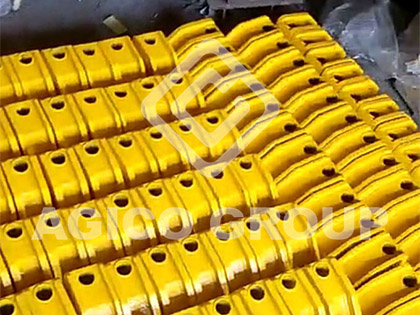
Rail Track Jack and Rack Jack
Railroad Track Jack Types for Sale
Unlike large-sized rail lifting and lining machines, track jacks are a type of portable tool used for maintaining railway tracks. It lifts the rails a certain distance off the ground, facilitating track maintenance. Based on their operating principles, track jacks are supplied in 2 series: YQB – Hydraulic Rail Jack and SCQ rack jack.
YQB - Hydraulic Rail Track Jack
YQB series hydraulic rail track jack has 4 models: YQB-150, YQB-200, YQB-250 and YQB-294. They are suitable for track lifting operations on 50Kg/m and 60Kg/m rails and turnouts. This machine uses a manual plunger pump to drive a piston upward, which in turn moves a lifting lever. This lifts up the wheel at the front of the lever quickly, achieving the purpose of lifting the track. It is a specialized tool for railway track lifting and maintenance, ensuring safety and reliability without encroaching on clearance gauges. It is a dual-purpose machine with high efficiency, easy operation, and reduced labor intensity.
| Parameter | YQB-150x95 | YQB-200x135 | YQB-250x150 | YQB-294x173 |
|---|---|---|---|---|
| Rated Lining Force (kN) | 150 | 200 | 250 | 294 |
| Rated Tamping Force (kN) | 95 | 135 | 150 | 173 |
| Max Lifting Stroke (mm) | 120 | 120 | 128 | 120 |
| Max Lining Stroke (mm) | 80 | 80 | 87 | 80 |
| Working Pressure (MPa) | 42 | 55 | 68 | 55 |
| No-load Efficiency (mm/time) | 7 | 6 | 6 | 4 |
| Handle Torque (N·m) | 440 | 500 | 500 | 560 |
| Weight (kg) | 22 | 24 | 26 | 27 |
| Dimensions (mm) | 500×180×240 | 500×180×240 | 540×180×240 | 530×150×251 |
SCQ - Mechanical Rack Jack
The rack jack is a mechanical rail jack tool that consists of a base, lifting hook, handle, pawl, jack, rack, and quick-release wheel. Its working method includes a sliding engagement between the lifting hook and rack, a hinged handle connects to the lifting hook, the pawl connects the handle and the rack, a jack is fixed to the lifting hook, and a rack is fixed to the base.
Compared to traditional track jacks, the handle requires single-stroke force. Rack jack offers the following advantages: smaller size, lighter weight, easier portability, and safer operation throughout the entire process.
| Parameter | SCQ150-KN | SCQ200-KN |
|---|---|---|
| Rated Lifting Force (Top Lift) | 147 kN | 200 kN |
| Rated Lifting Force (Hook Lift) | 78 kN | 78 kN |
| Lifting Stroke | ≥270 mm | ≥270 mm |
| Lifting per Stroke | 127 mm/stroke | 127 mm/stroke |
| Initial Height | 50 mm | 50 mm |
| Lever Length (User-supplied) | 1.5 m | 1.5 m |
| Maximum Operating Force at Full Load | 1920 N | 1920 N |
| Overall Dimensions (L × W × H) | 420 × 165 × 522 mm | 420 × 165 × 522 mm |
| Weight | ≤25 kg | ≤25 kg |
What is a track jack?
A track jack is a small rail-lifting and lining tool used to raise rails for filling ballast and track adjustment. The track jacks are available at AGICO in 2 types: hydraulic track jack and rack jack.
- The hydraulic track jack uses a manual plunger pump to drive a piston to lift the rails, with a system working pressure. It is equipped with an overflow valve for automatic overload unloading and is suitable for lifting and aligning rails weighing 43 kg/m to 75 kg/m.
- The rack jack uses a bottom-starting support structure; the rack rises 12.7 mm with each rotation. It has an improved design of a wear-reducing plate between the rack and the housing.
Track lifter applications: Railroad track jacks are widely used in scenarios such as sleeper sand padding and rail straightness maintenance. Typical models such as the YQD-147 are driven by high-pressure oil through Pascal's theorem, with a maximum lifting height of 220mm.
Hydraulic Track Jack Structure
The hydraulic track jack consists of a hydraulic cylinder, cylinder seat, oil tank, piston pump, bracket, base, and handle. The base, bracket, and cylinder seat are hinged together by pins to form a planar 4-bar linkage. The cylinder seat has a safety valve and a return valve.
Working principle: Swinging the handle to make the plunger pump work continuously (suction and pressure), forcing hydraulic oil into the working cylinder. The piston extends and offers a pushing force to the track roller vertically upward and horizontally, thus achieving the purpose of lifting and lining the rail track.
Hydraulic Track Jack Operation Steps
- Before the operation, a no-load test should be conducted on the machine to check whether all moving parts operate flexibly. Open the unloading valve, press down firmly on the track wheel, and check whether the unloading valve is reliable.
- Clear the ballast under the rails appropriately, and insert the tool under the rail from one side. If you need to lift the track, place the lifting wheel under the rail. If you need to move the track, wed the protruding part of the support rod into the bottom of the rail. Close the unloading valve upwards, and swing the handle back and forth to lift or move the track.
- If the rail cannot be moved to the desired position in one attempt, the unloading valve must be opened to return the machine to its initial position, and the above steps should be repeated until the rail is moved to the required position.
- If it is necessary to change the work location during operation, the track lifter can be placed on the rail, the hand handle can be inserted into the inclined tube behind the cylinder seat, and then pushed on the rail surface.
- After use, always return the machine to its initial position to avoid damage.
Rack Jack Operation Steps
- The track lifter should be placed smoothly and securely. Insert a 1.5-meter-long steel rod into the rocker arm hole and move it up and down repeatedly until the required lifting height is reached.
- Move the slow descent control handle upwards to the brake position and move the lever up and down. Each reciprocation will lower the lever by one tooth.
- Pull out the lever and use it to strike the tail of the descent footplate vertically, which will allow you to descend to the starting position in one go.
We receive enquiries in English, Español (Spanish), Русский язык (Russian), Français (French) and العربية (Arabic). Our professional team will reply to you within one business day. Please feel free to contact us!