SND-23 Rail Tamping Machine
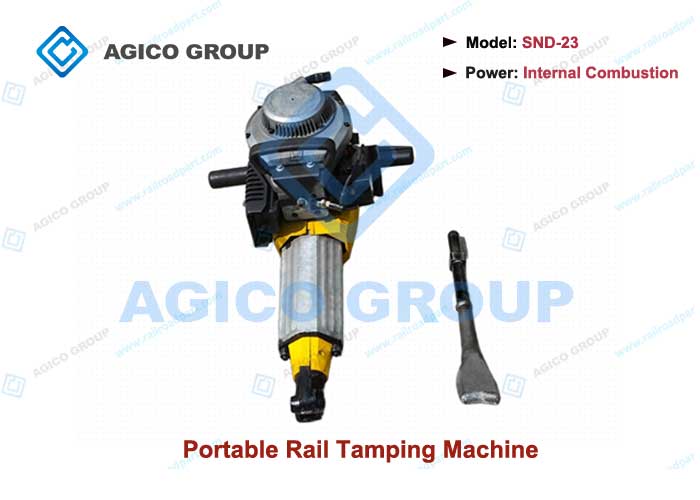
SND-23 Rail Tamping Machine Introduction
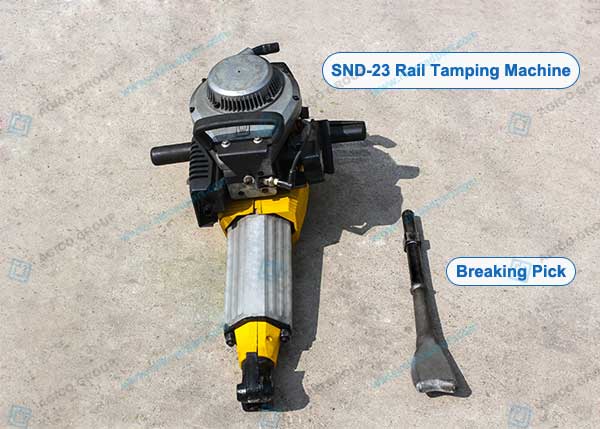
The SND-23 rail tamping machine is a portable ballast tamping tool supplied by AGICO for railway tracks. It is powered by a gasoline engine, which generates high-frequency disturbing force through a centrifugal clutch, rubber damper, and vibration exciter, and finally to the breaking pick rearranges the ballast beneath the rail sleepers. Besides SND-23 rail tamping machine, AGICO also offers other rail ballast tamping machine models such as: SND-23, YCD-23, YD-22 I, II, III, NRD-4.
Feature: This rail tamper model features an innovative design, compact structure, small size, light weight, high maneuverability, two-stage handle damping, and portability. It can be easily moved on and off the track without requiring line closure. The SND-23 rail tamping machine is especially suitable for ballast tamping work for turnout, tunnel, bridge, and culvert sections, especially where large-scale maintenance machinery cannot operate.
SND-23 Rail Tamping Machine Advanced Design
A dedicated gasoline engine powers the SND-23 model rail tamping machine; no external air compressor or power supply is required. It has a compact structure. The reciprocating impact hammer design ensures superior performance; spring-hinge damping provides comfortable operation; all-metal components are electrophoretically coated and baked.
By replacing different attachments, the SND-23 rail tamping machine can perform tasks of tamping, breaking, chiseling, pile driving, compacting, splitting, drilling, etc., making it widely applicable in railway maintenance, road repair, civil engineering demolition, and mining operations.
Technical Parameters of SND-23 Portable Rail Tamper
| Item | Specification |
|---|---|
| Overall Dimensions (L × W × H) | 450 × 340 × 790 mm |
| Engine Type | Single Cylinder, Air-cooled, Two-stroke |
| Displacement (ml) | 80 |
| Weight without Tools (kg) | 23 |
| Impact Frequency (1/min) | 1300 |
| Impact Energy (J) | 55 |
| Idle Speed (r/min) | 2500 ± 250 |
| Rated Speed (r/min) | 1800 ± 180 |
| Working Speed (r/min) | 4250 |
| Fuel | Gasoline & Oil Mixture Ratio (25~30):1 |
| Fuel Tank Capacity (L) | 24L |
| Impact System Grease | (-30-180)℃ Lithium-based Grease 350 g |
How does SND-23 Rail Tamping Machine Work
Engine power is transmitted from the driven disc to the gearbox. After gear reduction, the crankshaft gear drives the connecting rod, piston, and inner cylinder to move up and down, striking the breaking pick, which then delivers high-frequency, high-energy impacts to the object to be broken.
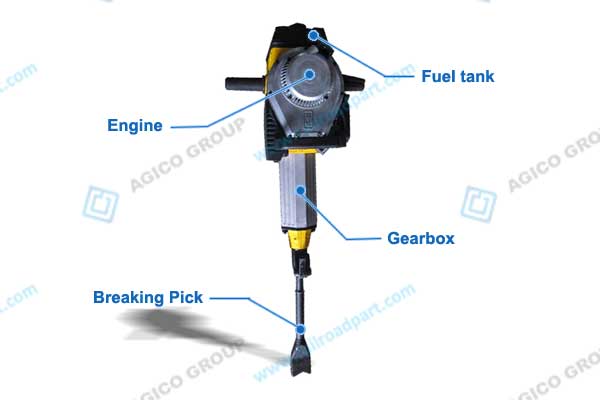
Structural of SND-23 Rail Tamping Machine
- Fuel tank: Stores fuel.
- Engine: Outputs power and connects to the crankcase via clutch.
- Gearbox: Gear reduction unit that transmits torque.
- Breaking pick: Working component that can be replaced with different tools depending on the operation.
Contact us now for the diagram for detailed structure.
SND-23 Rail Tamping Machine Operation Tips
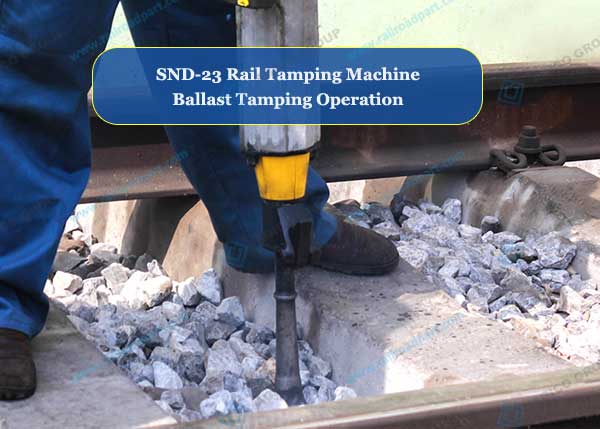
While handling the SND-23 rail tamping machine, hold the handle firmly with both hands and increase throttle to an appropriate level for breaking. After ballast tamping is completed, reduce throttle and lift the rail tamper to the next position to restart. No-load operation or overspeeding should be avoided.
- When using rail tamper to break hard surfaces, adjust appropriate angles and breaking points, avoid any damage and increase efficiency.
- Don’t insert the rail tamper too deeply into the ballast to prevent pinching.
- The operator can use 2 rail tampers side by side to double the working efficiency.
It takes 3 steps preparation work before starting the SND-23 rail tamping machine:
Fueling: Use 90# or higher gasoline and two-stroke engine oil. Mix at the ratio specified on the oil container (if not specified, use 25:1–30:1 gasoline to oil). Mix thoroughly in a fuel container before filling. Do not allow dirt to enter the tank. Do not store mixed fuel in the tank for extended periods.
Warning:
- Do not use pure gasoline or a mixture leaner than 30:1.
- Refuel in well-ventilated areas with the engine stopped.
- No open flames during refueling.
- Do not overfill the tank. Ensure the fuel cap is tightened after refueling.
- If fuel spills, clean it thoroughly and allow vapors to dissipate before starting the engine.
Inspection:
- Place the breaker on loose sand or gravel.
- Check that all connections are tight.
- Check spark plug gap (0.8–0.9 mm).
- Pull the starter cord 2–3 times lightly to check engine operation.
- Check if the air filter is dirty.
Warning: Never run the engine without the air filter, as this will accelerate engine wear.
2. Starting Engine
Follow the steps below:
-
Open the fuel valve and set the choke to the closed position (Figure 2). If the engine is warm or the ambient temperature is high, fully open the choke.
Warning: When restarting a warm engine, the muffler is hot. Avoid contact to prevent burns. - Set the throttle to 1/3–1/2 position.
-
Pull the starter cord gently a few times, then pull quickly to start the engine.
Note: Do not allow the starter cord to retract on its own. Hold the handle and return it slowly to prevent damage. - After the engine starts, gradually open the choke fully.
-
For a cold start, allow the engine to run at low speed for 3–5 minutes before operation.
Note: For a new engine, operate at half throttle under light load for the first 24 hours for proper break-in.
3. Shut down the SND-23 Rail Tamper
For emergency stops, the operator shall press and hold the stop switch for 3–5 seconds. Under normal conditions:
- Gradually release the throttle and allow the engine to idle for 3–5 minutes.
- Press the stop switch (Figure 2).
- Close the fuel valve after the work is completed.
Maintenance Tips of Rail Tamping Machine
Regular maintenance is necessary to keep the SND-23 rail tamping machine in good condition. Poor maintenance can create safety hazards. We recommend having maintenance performed by authorized workers. If users have the appropriate tools, materials, and mechanical skills, they may perform the following maintenance procedures.
Note: Improper maintenance can seriously affect machine service life and working performance.
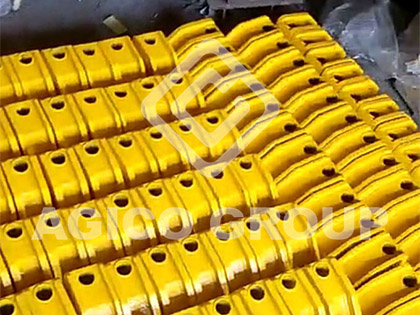
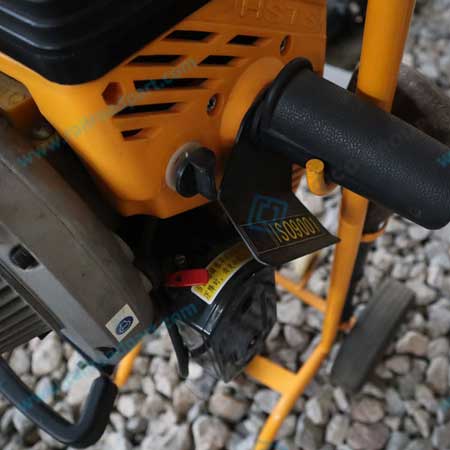 SND-23 Rail Tamping Machine on Shelf
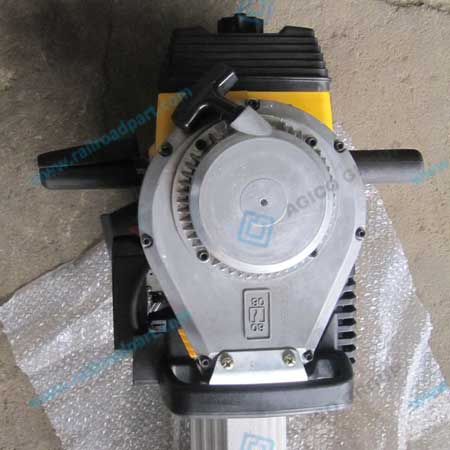 Upper part of SND-23 Rail Tamping Machine
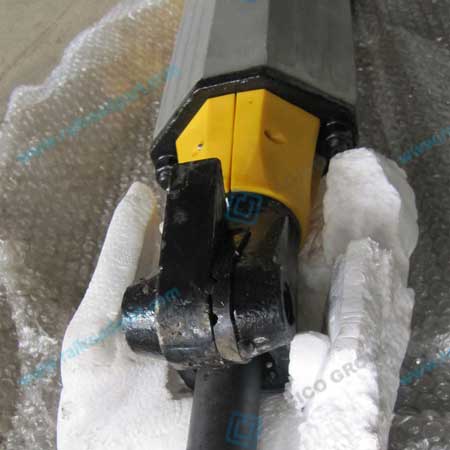 Lower part of SND-23 Rail Tamping Machine
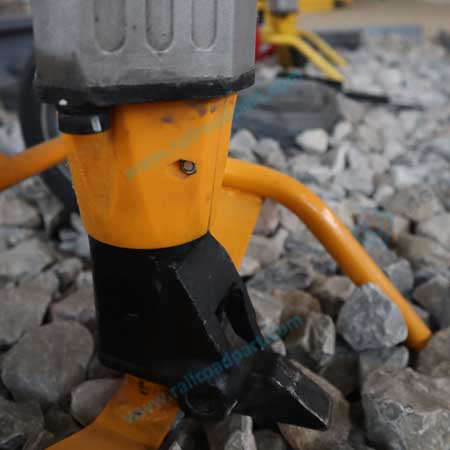 Breaking Pick Install Part Detail
- Air Filter Maintenance: A dirty air filter restricts air flow to the carburetor, leading to carburetor issues, increased engine wear, and reduced power. Clean the air filter regularly, especially in dusty environments. If the filter element is clogged, wash it and the inside of the filter housing with gasoline. After cleaning, apply a few drops of oil to the element, squeeze out excess, and reinstall. (Note: Do not allow dirt to enter the engine intake during cleaning.)
- Spark Plug Maintenance: To ensure normal engine operation, the spark plug gap must be correct and free of deposits. The recommended gap is 0.8–0.9 mm. Check frequently and adjust as needed. ( Note: Do not use a spark plug with incorrect heat range. The model for this machine is E4RTC.)
- Lubrication: Apply grease every 20 working hours.
- Screws: After the first 8 hours of use, check weekly and retighten all screws, applying thread-locking compound where necessary.
| After First 8 Hours: Check and Tighten All Fasteners | ||
|---|---|---|
| Item | Maintenance Work | Interval |
| Air Filter Nut | Check for looseness or damage | Daily |
| Fuel Tank | Check if cap is tightened; replace if necessary | Daily |
| Starter Rope | Check for damage or jamming; replace if necessary | Daily |
| Tools | Repair, forge or replace if necessary | Daily |
| Air Filter | Clean or replace | Weekly |
| Cylinder | Remove deposits | Weekly |
| Fasteners | Check for looseness; replace if necessary | Weekly |
| Ignition System | Clean carbon deposits and check spark plug gap | Monthly |
| Connecting Sleeve | Replace if wear is excessive | Monthly |
| Lubricating Grease | Refill grease | Every 20 hours |
| Long Bolts | Check looseness, tighten if necessary (Torque 75 Nm) | Every 80 hours |
| Crankshaft Gear | Open and apply grease | Every 600 hours |
Engine & Equipment Troubleshooting Guide
1. Engine Fails to Start – No Spark or Fuel Delivery
| Phenomenon | Cause | Remedy |
|---|---|---|
| Electrode moist / Wet spark plug | Humidity / condensation | Dry thoroughly |
| Carbon deposit on spark plug | Carbon accumulation | Clean spark plug |
| Spark plug electrode gap incorrect | Gap too large or too small | Adjust gap to 0.8–0.9 mm |
| Spark plug insulation damaged | Cracked or broken insulator | Replace spark plug |
| Spark plug electrode burnt | Excessive wear / overheating | Replace spark plug |
| High-tension wire sheath damaged | Broken insulation / wire exposed | Repair or replace wire |
| Magneto / electronic ignition module faulty | Igniter damaged | Replace ignition module |
| Excessive fuel drawn into cylinder | Carburetor flooding / over-rich mixture | Reduce fuel supply / adjust carburetor |
| Good compression but engine fails to run | Poor fuel quality (contaminated / old fuel) | Replace with fresh, quality fuel |
| No fuel in tank | Empty tank | Add fuel |
| Carburetor does not supply fuel | Fuel strainer / filter clogged | Clean strainer or filter |
| Carburetor does not supply fuel | Fuel tank vent hole blocked | Clear vent hole |
2. Insufficient Power Output
| Phenomenon | Cause | Remedy |
|---|---|---|
| Lack of power / poor acceleration | Air filter element clogged | Clean or replace air filter |
| Engine runs poorly / misfires | Water or moisture in fuel | Replace fuel |
| Engine overheats, power drops | Overheating condition (general) | Stop engine and allow to cool |
| Reduced power / exhaust blocked | Carbon buildup in muffler / spark arrester | Remove carbon deposits |
| Engine lacks power / hesitates | Fuel mixture too lean (carburetor setting) | Adjust carburetor to richer mixture |
| Engine overheats frequently | Carbon deposits on cylinder head | Decarbonize cylinder head |
| Engine overheats / excessive friction | Poor quality or incorrect lubricating oil | Use specified special engine oil |
| Engine overheating / knocking | Low quality fuel (low octane / contamination) | Replace with good quality fuel |
| Abnormal knocking / pinging sound | Carbon buildup in combustion chamber | Remove carbon deposits |
| Metallic knocking or rattling | Worn moving parts (bearings, piston, etc.) | Inspect and replace worn components |
3. Engine Stops During Operation
| Phenomenon | Cause | Remedy |
|---|---|---|
| Sudden engine stop / intermittent spark | Spark plug lead loose or disconnected | Secure connection firmly |
| Engine suddenly stops / seizes | Piston seized due to overheating or lack of lubrication | Repair or replace piston/cylinder assembly |
| Sudden engine stop (while running) | Carbon buildup on spark plug causing misfire | Clean or replace spark plug |
| Sudden engine stop | Fuel tank empty | Refuel |
| Sudden engine stop / fuel starvation | Carburetor internal passages clogged | Clean carburetor thoroughly |
| Engine gradually loses power and stops | Fuel tank vent hole blocked (vacuum in tank) | Clear vent hole |
| Engine gradually slows down and stops | Water contamination in fuel | Drain fuel system and replace with fresh fuel |
4. Tool / Equipment Malfunction (Abnormal Operation)
| Phenomenon | Cause | Remedy |
|---|---|---|
| No power transmission / slipping | Clutch defective or worn | Replace clutch assembly |
| Unusual noise / no drive | Gear broken or severely worn | Replace damaged gear(s) |
| No work output or weak operation | Insufficient internal cylinder pressure (seal failure) | Replace cylinder / repair sealing components |
| Irregular / erratic movement | Foreign debris or dirt inside cylinder | Clean interior thoroughly |
| Misalignment / poor operation | Connecting flange poor guiding or worn | Replace flange / guiding components |
| Reduced performance / inefficient work | Worn tool attachment or working element | Repair or replace worn tool parts |
| Squeaking / rough operation / increased friction | Insufficient lubricating grease | Add specified grease / lubricant |
| Abnormal noise (rattling / grinding) | Broken or damaged internal component | Inspect and replace defective parts |
| Sudden noise / irregular sound | Foreign object entered mechanism | Remove foreign object; clean area |
Note: Always refer to the equipment manufacturer’s manual for detailed service procedures. Regular maintenance helps prevent most failures.
We receive enquiries in English, Español (Spanish), Русский язык (Russian), Français (French) and العربية (Arabic). Our professional team will reply to you within one business day. Please feel free to contact us!
- Rail Fasteners
- Rail Joints
- Rail Track Parts
- Railway Sleeper
- Railroad Maintenance
- ◆ Railroad Grinders
- ◆ Ballast Tamping Machines
- ◆ Rail Cutting Machines
- ◆ Rail Drilling Machines
- ◆ Hydraulic Rail Benders
- ◆ Rail Pullers and Tensors
- ◆ Rail Wrenches
- ◆ Rail Bolt Lubricator
- ◆ Shoulder Ballast Cleaner
- ◆ Drills and Grinding Wheels
- ◆ Track Lifting and Lining Machine
- ◆ Rail Track Jack
- ◆ Rail Track Welding Machine
- ◆ Thermit Welding Kits
- ◆ Rail Gauge Rod
- Railroad Rails