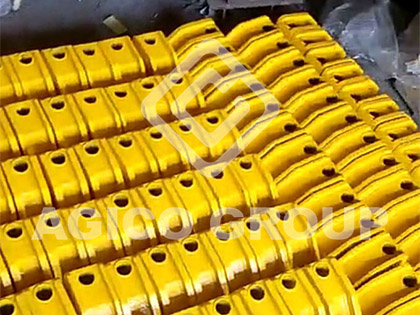
Introduction of fishplate types used in india

Various Fishplate Types Used in India
Everyone knows that railway fasteners in railway track function is to fix rails to rail sleepers for safety running of trains. Replacement shall be done after they served thier purpose untile it is worn and can’t maintain the level, alignment and gauge. For Rail clips, it is fastening rails to sleepers; for Fishplates, it is connecting steel rail ends, in one word hold steel rails in position in both horizontal and vertical planes.
Fishplate also known as rail joint bar has 4 major types: Standard Fishplate, Joggled Fishplate, Special Fishplate, Combination/Compromised fishplate.
Why it is safeto use fishplate? Take Indian fishplate for example, 1 piece of fishplate minimum tensile strength is 5.58-6.51 t/cm2 and 20% elongation. Fishplate was designed to have same strength of steel rail section. One piece of rail section is about 55% of rail sections, so 2 pieces fishplate is more stronger than steel rail profile.
I. Indian Fishplate Steel Chemical Elements
Indian railway has its own standard, for example: (IRS T-1/57), a fishplate shall be manufactured using a special type of steel with composition given below, its main chemical composition is as below:
- a. Carbon: 0.30–0.42%
- b. Manganese: not more than 0.6%
- c. Silicon: not more than 0.15%
- d. Sulphur and phosphorous: not more than 0.06%
II. Joggled Fishplate
Joggled fishplate is used while rail joint maintainence or emergency repairs, it has unique shape to leave space for welding steel rails with defective. Mostly applicated in seamless steel rails, it is a necessary part in keeping rail joints safety when there is hidden danger.
III. Special Fishplate
The track portion to be detected has to be electrically isolated from adjoining rails so as to block the track circuit current, within its boundaries by providing Insulated rail joints or Block joints at each end of track circuit. In general Insulated rail joints or Block joints are required at the boundaries of the track circuit and at point & crossings where the polarity of track circuit is to be changed.
There are 3 types of insulated rail joints or block joints that are presently in use as given below:
- Insulated rail joint class "A"—these Insulation joints are made of special type of wood and used in yards where speed of train is slow.
- Insulated rail joint class "B"—these Insulation rail joints are made up of Nylon 66. These are also called Nylon insulated rail joint.
- Insulated rail joint class "C"—these are also called as glued insulated rail joints. Glued insulated rail joints. These are mostly used in main line for high speed trains. The glued joints are being increasingly provided on railways to avoid failures of insulation joints particularly in long welded rails. There are two types of glued joints: G3 (L) type - six bolts, G3 (S) type - four bolts.
IV. Compromised Fishplate

Combination fishplate, also named compromised fishplate, is used to connect two different rail sections. The design is to cover the rail section at either end adequately up to the point in the centre where the rail section changes. Another design feature is the elimination of the expansion gap to give them more strength. The varying depths of the combination fishplates can be used in the rail sections, for example, 52 kg/90 R, 90 R/75 R, 75 R/60 R, etc., which provides a common top table for the two rail sections they join.
When two different grades steel rail are used together, obviously there is going to be a difference in the sectional area, as well as the sectional weight of those rail sections. So in that sense one rail section which is having a lesser weight will be termed as a lighter rail another rail section will be termed as heavier rail. Based on the location of the lighter rail and heavier rail, the fishplates are marked right in, right out, left in, and left out depending upon their positions.
We receive enquiries in English, Español (Spanish), Русский язык (Russian), Français (French) and العربية (Arabic). Our professional team will reply to you within one business day. Please feel free to contact us!
- Rail Fasteners
- Rail Joints
- Rail Track Parts
- Railway Sleeper
- Railroad Maintenance
- ◆ Railroad Grinders
- ◆ Ballast Tamping Machines
- ◆ Rail Cutting Machines
- ◆ Rail Drilling Machines
- ◆ Hydraulic Rail Benders
- ◆ Rail Pullers and Tensors
- ◆ Rail Wrenches
- ◆ Rail Bolt Lubricator
- ◆ Shoulder Ballast Cleaner
- ◆ Drills and Grinding Wheels
- ◆ Track Lifting and Lining Machine
- ◆ Rail Track Jack
- ◆ Rail Track Welding Machine
- ◆ Thermit Welding Kits
- ◆ Rail Gauge Rod
- Railroad Rails